


You'll remember Vizontele… Cem Yılmaz's legendary line, “So will Zeki Müren see us too?”, captures so simply yet so powerfully the excitement of the public's first encounter with television in the '70s.
So now, in this period of yet another great technology revolution, this time I'm the one asking: Will AI see us too? :)
The answer: I hope so.
Today we all benefit from AI in our daily lives and our work. But now the new agenda is this: AI showing you, your venture and your brand accurately and the way you want. If the opposite happens… well, that's a bit of a disaster scenario (I explained this in the masterpiece video I created with Veo in this post, too).
For entrepreneurs, the situation is even more critical. VCs now use AI seriously in their research. Likewise, companies looking for products start by asking AI first. In other words, the information AI gives about your venture can help an investor find you—and it can bring in a large customer as a lead.
From what I've seen in this field, although the terminology doesn't seem fully settled yet, one of the most-used terms emerging is GEO, i.e., the concept of Generative Engine Optimization.
At first SEO entered our lives, then ASO in the mobile era, and now the GEO era has begun. So the king will now be whoever succeeds at GEO.
What's more, gaining visibility with GEO is free. That is, it's not possible for someone with a budget to jump ahead of you with promoted content. For now...
(Elon Musk plans to bring ads to Grok; we'll surely see ad models on different platforms soon. So it won't stay free like this. But coming back to today, while Google's rewarding of clickbait and its “whoever pays comes out on top” policy make organic traffic harder, I can say that AI chatbots currently offer a great opportunity to lesser-known brands and startups.)
So how can we become more visible to AI? The most concise answer: by focusing in the content you create not on keywords but on the meaning of the content. In other words, what matters now is a bit more the customer's true intent, not the search words they chose. Looking at the positive side, perhaps an era of reaching real information—getting out of the keyword junkyard—awaits us.
Details?
Will GEO replace SEO?
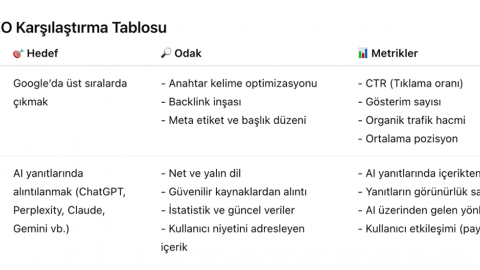
As HubSpot also notes: many things done well in SEO can be carried over to GEO. Quality content, reliable sources and expertise signals are critically important on both sides.
How Do Generative Engines Work?
The way to understand GEO runs through first knowing how Generative Engines (GE) work.
GEs, very simply, consist of two basic components:
1. Understanding and reformulating the query (intent analysis, summarization, context resolution).
2. Pulling and synthesizing relevant sources.
So when a user asks a question, it doesn't just look at the words. The AI first understands the intent behind the question, then gathers information from different sources, summarizes it and produces the most suitable answer.
For example: when an investor asks, “What are the newest fintech startups in Türkiye?”, the AI doesn't just search for the word “fintech.” It first resolves the intent of the question (to learn about investment opportunities). Then it gathers the relevant startups from different sources (news, LinkedIn, websites, articles), summarizes this information and produces a clear list suited to the investor's need.
The same logic applies when a customer asks, “Who are the competitors of product X?” The AI extracts the competitors, summarizes their strengths/weaknesses and prepares an answer suited to the user's context.
The Benefits of GEO
· Visibility: Appearing directly in AI answers accelerates branding.
· User experience: Intent-focused, concise content increases credibility.
· Future readiness: According to Gartner, by 2026 there will be a 25% drop in traditional searches. GEO prepares content for this new order.
· Contextual relevance: AI responds according to user context (location, preference, behavior).
· Competitive advantage: Early adopters of GEO can achieve visibility increases of 30-40%, and small businesses up to 115%.
How to Do GEO
1. Do AI research: try queries related to your industry in tools like ChatGPT, Claude and Perplexity. Examine which content the AI uses as sources.
2. Produce authoritative content: write clearly and plainly. Support it with statistics, quotes and reliable sources. Add unique insights and actionable advice. Meet the E-E-A-T (Experience, Expertise, Authoritativeness, Trustworthiness) criteria.
3. Structure your content: clear headings (H2, H3). Lists, tables, bullet points. Short sentences, short paragraphs. Direct quotes. Schema markup.
4. Distribute strategically: share on places like LinkedIn, X (Twitter), Instagram, Quora and Reddit. AI pulls data from these.
5. Don't forget the technical side: page speed, crawlability, structured data.
6. Use multimedia: images, videos, infographics.
7. Experiment and iterate: run A/B tests on format, length and tone.
In Short:
As content production increases, so does competition. That's why producing original and accurate content is more valuable than ever. AI platforms, too, are genuinely after meaning and value. They focus on essential information rather than marketing jargon.
There is a great window of opportunity for ventures that want to make themselves known. What needs to be done now is to plan in detail and leave original footprints in the digital environment ✨


